- Resources
Table of Contents

Better Options and Add-Ons

Best Overall Reliability

Best Satellite Speeds
Satellite internet is a type of broadband internet service that sends data from your home up to satellites in orbit and back down to the internet provider hub on the ground. Because it doesn’t rely on cables and only needs a clear view of the southern sky, it’s available in most places, making it one of the few rural internet options.
LEO (Low Earth Orbit) and GEO (Geostationary Earth Orbit) are two ways satellites “sit” in space, and that orbit choice affects performance.
LEO satellite internet uses an array, or constellation, of satellites that orbit at low altitudes. Because the signal travels a shorter distance, LEO typically delivers lower latency (more responsive internet), which helps with video calls, online gaming, and remote work apps. Since LEO networks rely on a large constellation of satellites and ground stations, performance can vary by location, network congestion, and an unobstructed view of the sky.
GEO satellite internet has satellites orbiting at much higher altitudes that are synced with Earth’s rotation, so they appear fixed in one spot above the planet. This makes GEO satellite internet more widely available, but with slower speeds and higher latency due to the distance signals must travel. It can work well for web browsing, streaming, and email, but it can feel sluggish for real-time activities like competitive gaming or video conferencing.
LEO and GEO quick comparison:
If you want the most “cable-like” feel from satellite, LEO is typically the better fit. If you only need basic internet access and have limited options, GEO is acceptable for most online activities.
Satellite internet is one of the few “almost anywhere” options. It doesn’t rely on cables and only needs a clear view of the southern sky, which is why it’s a popular rural and remote internet option, as well as for mobile and RV internet.
Latency is the biggest drawback (especially for gaming and real-time apps). Traditional GEO satellite plans average about 600 ms, while Starlink (LEO) averages about 30 ms, making it the more responsive, albeit more expensive, choice.
Expect acceptable download speeds, but modest uploads. Top download speed for GEO is 150 Mbps, and 200 Mbps for LEO satellite internet. For upload speeds, the max for GEO is 5 Mbps, and about 25 Mbps for LEO.
“Unlimited data” often comes with fine print. Several providers are described as having priority data or soft caps, where speeds may be slowed or deprioritized after heavy use or when the high-speed data limit is reached.
Equipment affects overall cost. Satellite internet is the most expensive connection type when you compare top speed to monthly price. The need for professional installation and specific equipment are upfront costs to consider when comparing internet providers.
It depends on where you live and what other types of internet connections are available in your area. In some cases, satellite internet may be the only option for those living in rural areas. It offers connectivity where other types of internet connections can’t reach, keeping you online for working from home, gaming online, and streaming video. Satellite internet can also provide connectivity if you’re a frequent traveler or live a mobile lifestyle.
But if you live in an area where other options, like fiber, cable, or 5G home internet, are available, they may offer faster speeds at a lower cost. If you’re considering satellite internet, it’s a good idea to run an internet speed test before switching to compare it to satellite internet speeds.
Available almost anywhere
Growing number of satellite providers
Ideal for rural residents
High internet latency
Slower than other types of internet
On the expensive side
| Provider | Starting Price* | Download / Upload
(up to)** |
Latency | Data Policy | Additional Fees | Find Plan |
|---|---|---|---|---|---|---|
| EarthLink (Satellite) | $60/mo | Up to 100 / 3 Mbps | 600+ ms (GEO) | Capped plans (e.g., 100–300 GB); slowed after cap | Equipment rental, setup, activation fees | Check Availability |
| Viasat | $40/mo | Up to 150 / 3 Mbps | 600–700 ms | “Unlimited” with soft caps; deprioritized after heavy use | Equipment lease, potential install, early-termination fees | Check Availability |
| HughesNet | $40/mo | Up to 100 / 5 Mbps | 600–700 ms | Unlimited with priority data (e.g., 100–200 GB), then slower | Modem rental, 24-mo contract, early-termination fees | Check Availability |
| Starlink | $40/mo | 50–220 / 10–25 Mbps | 25–60 ms (LEO) | Unlimited with Fair Use; slowedat very high usage | Upfront hardware or financing; shipping, taxes | Check Availability |
| Provider | EarthLink (Satellite) |
|---|---|
| Starting Price* | $60/mo |
| Download / Upload
(up to)** |
Up to 100 / 3 Mbps |
| Latency | 600+ ms (GEO) |
| Data Policy | Capped plans (e.g., 100â300 GB); slowed after cap |
| Additional Fees | Equipment rental, setup, activation fees |
| Find Plan | Check Availability |
| Provider | Viasat |
| Starting Price* | $40/mo |
| Download / Upload
(up to)** |
Up to 150 / 3 Mbps |
| Latency | 600â700 ms |
| Data Policy | âUnlimitedâ with soft caps; deprioritized after heavy use |
| Additional Fees | Equipment lease, potential install, early-termination fees |
| Find Plan | Check Availability |
| Provider | HughesNet |
| Starting Price* | $40/mo |
| Download / Upload
(up to)** |
Up to 100 / 5 Mbps |
| Latency | 600â700 ms |
| Data Policy | Unlimited with priority data (e.g., 100â200 GB), then slower |
| Additional Fees | Modem rental, 24-mo contract, early-termination fees |
| Find Plan | Check Availability |
| Provider | Starlink |
| Starting Price* | $40/mo |
| Download / Upload
(up to)** |
50â220 / 10â25 Mbps |
| Latency | 25â60 ms (LEO) |
| Data Policy | Unlimited with Fair Use; slowedat very high usage |
| Additional Fees | Upfront hardware or financing; shipping, taxes |
| Find Plan | Check Availability |

The availability of satellite internet makes it an ideal option for those that live in rural areas, travel frequently, or live the mobile lifestyle. It provides broadband speeds and a reliable connection where other types of internet cannot.
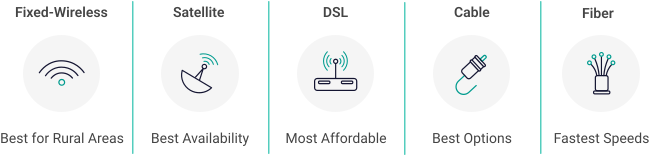
Satellite internet differs from ground-based internet connections, such as cable and fiber internet. Since it doesn’t rely on wireline but rather satellites orbiting the earth, it is available anywhere with a clear view of the southern sky. This makes it ideal for rural residents, but where it excels in availability, it lacks in speed and low internet latency. It can also be disrupted by severe weather conditions. Due to the high operating costs of satellite internet, it is one of the most expensive types of internet.
| Connection Type | Download / Upload
(Mbps) |
Latency | Starter Price* | Data Policy | Equipment / Install | Contract |
| Satellite | 25-200 / 3-25 | 40-60 ms (LEO); 500 ms (GEO) | $60/mo | Unlimited with soft caps; speeds slowed after high-speed cap | Roof dish, modem; self or pro install | Often no-term; some 1-2 yr |
| Fiber | 300-2,000 / 300-2,000 | 5-15 ms | $40/mo | Usually truly unlimited | ONT, Wi-Fi gateway; pro or self | Mostly no-term; promo price locks |
| Cable | 100-1,000 / 10-35 | 10-25 ms | $30/mo | Unlimited or 1.2 TB caps | Cable modem, router; easy self-install | Often no-term; promo rates 12 mos |
| DSL | 5-100 / 1-10 | 20-50 ms | $40/mo | Usually unlimited | DSL modem, router over phone jack | Frequently month-to-month / price-for-life |
| 5G Home | 100-300 / 10-50 | 20-40 ms (varies) | $35/mo | Unlimited with possible deprioritization | 5G gateway; plug-and-play self-install | No-term; price guarantees common |
| Connection Type | Satellite |
| Download / Upload
(Mbps) |
25-200 / 3-25 |
| Latency | 40-60 ms (LEO); 500 ms (GEO) |
| Starter Price* | $60/mo |
| Data Policy | Unlimited with soft caps; speeds slowed after high-speed cap |
| Equipment / Install | Roof dish, modem; self or pro install |
| Contract | Often no-term; some 1-2 yr |
| Connection Type | Fiber |
| Download / Upload
(Mbps) |
300-2,000 / 300-2,000 |
| Latency | 5-15 ms |
| Starter Price* | $40/mo |
| Data Policy | Usually truly unlimited |
| Equipment / Install | ONT, Wi-Fi gateway; pro or self |
| Contract | Mostly no-term; promo price locks |
| Connection Type | Cable |
| Download / Upload
(Mbps) |
100-1,000 / 10-35 |
| Latency | 10-25 ms |
| Starter Price* | $30/mo |
| Data Policy | Unlimited or 1.2 TB caps |
| Equipment / Install | Cable modem, router; easy self-install |
| Contract | Often no-term; promo rates 12 mos |
| Connection Type | DSL |
| Download / Upload
(Mbps) |
5-100 / 1-10 |
| Latency | 20-50 ms |
| Starter Price* | $40/mo |
| Data Policy | Usually unlimited |
| Equipment / Install | DSL modem, router over phone jack |
| Contract | Frequently month-to-month / price-for-life |
| Connection Type | 5G Home |
| Download / Upload
(Mbps) |
100-300 / 10-50 |
| Latency | 20-40 ms (varies) |
| Starter Price* | $35/mo |
| Data Policy | Unlimited with possible deprioritization |
| Equipment / Install | 5G gateway; plug-and-play self-install |
| Contract | No-term; price guarantees common |
Between hidden fees and price hikes, finding the right internet plan can feel overwhelming. To help with your search, our team of internet experts evaluates ISPs on categories including performance, affordability, and customer satisfaction to provide you with the best options near you.
DSL internet and satellite internet deliver comparable speeds. Both can offer speeds up to 100 Mbps, however, DSL is usually more reliable than satellite for its grounded wire technology. Satellite internet is susceptible to service interruptions due to bad weather or faulty equipment, while DSL runs along grounded telephone lines that are protected from the elements.
If you decide to go with satellite internet, you may be able to get speeds from 25 Mbps to 150 Mbps in speeds. These speeds can support low to moderate internet usage like web browsing and occasional streaming. However, everyone’s needs are unique. The internet speed you need will depend on your lifestyle.
If Viasat internet is available in your area, you can enjoy some of the fastest speeds on the market, with download speeds of up to 100 Mbps and upload speeds of up to 3 Mbps. However, in some areas, Viasat only offers speeds up to 12 Mbps.
Starklink deploys satellite technology that uses low-Earth-orbit satellites to deliver faster internet speeds to residential customers than traditional satellite technology can.
Right now, customers are able to receive anywhere from 50-150 Mbps depending on how far they are from satellites in the sky. However, once fully deployed, Starlink internet is anticipated to offer equal download and upload speeds of up to 1,000 Mbps. That’s unheard of for satellite internet like HughesNet and Viasat. Starlink is currently taking reservations, but the equipment may not ship until 2025.